Can you tell when an AI-generated structural calculation is wrong?
The calculations looked detailed, formatted and confident. They were also wrong, and nobody competent had checked them.
In July 2026 the Collaborative Reporting for Safer Structures published Safety Report 1554. A reporter described an architect who had relied on AI-generated calculations to justify additional roof loading on a building, without verification by a competent structural engineer. The output looked credible. It contained fundamental errors, and the report records a risk of structural overloading.
The uncomfortable part is not that the calculations were wrong. It is that they were convincing. A wrong answer that looks right will pass a review that only looks at presentation.
Why the wrong answer survives a skim
Structural engineers are trained to spot a particular kind of error: the arithmetic slip, the missing load case, the bracket in the wrong place. AI does not usually make those. It makes the errors that are hardest to see, because nothing about them looks out of place:
- a support condition that is wrong for the structure — a fixed end where there is a pin, or a pin where the connection can rotate;
- a load path that does not close, so the reactions do not add up to the applied load;
- a bending moment diagram that is not in equilibrium with its own shears;
- a load applied in the wrong direction — roof loading in particular is not only gravity.
Each of these produces a page that reads well. The check that catches them is not a reading check. It is a prediction: knowing what the answer should look like before you look at it.
Three questions, asked in this order
This is the method the courses teach, and it works on any structure and any source of output — AI, software, or a colleague under time pressure.
1. What shape does it deflect into?
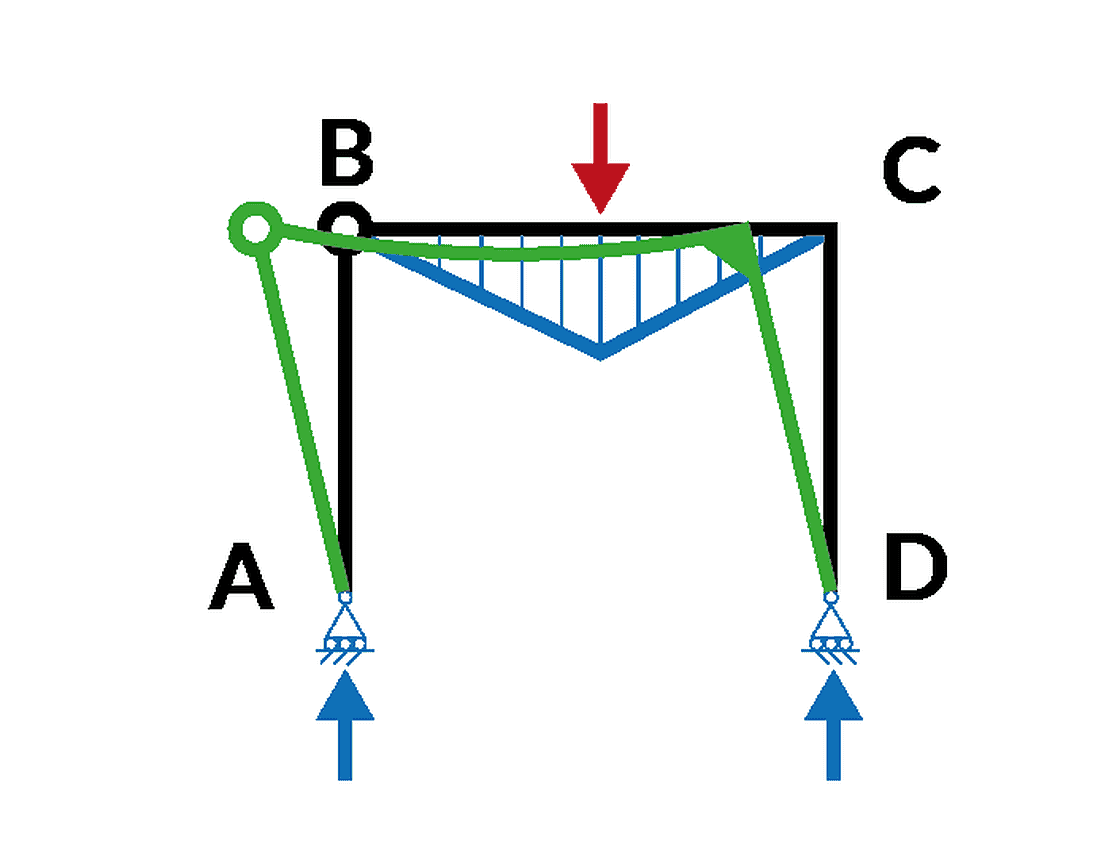
Sketch the deflected shape before you look at the numbers. Where does the load go, which spans sag, which corners open, where does the structure have to move because nothing else can. A deflected shape is a whole-structure statement about how the load reaches the ground. If the calculation’s behaviour does not match your sketch, one of you is wrong, and it is worth finding out which before reading further.
2. Do the reactions close?
Add up the applied loads, add up the reactions, and check the directions. This is equilibrium, and it is not optional: it either closes or the analysis is wrong. It is also the fastest check available, because it needs no understanding of the internal distribution at all. A tool that fails equilibrium has failed everything.
3. Does the bending moment diagram make sense?
Check the shape, the signs and the magnitudes. Hogging where you expect hogging. Zero at a genuine pin, not zero at a fixed end. Maximum where the shear crosses zero. A continuous curve without a kink at a point load. Each of these is a check on the other two: the diagram has to be consistent with the deflected shape and in equilibrium with the reactions.
When all three agree, you have a structural answer worth checking arithmetically. When they disagree, you have found the error without opening a calculator.
A check you can do on the back of an envelope
Take a simply supported beam of span L carrying a uniform load w.
- Each reaction is wL/2, and together they equal the total load wL.
- Shear is zero at midspan.
- The maximum bending moment is wL²/8, at midspan.
Those three facts take a moment to write down and they are enough to catch most wrong answers. A tool that reports a fixed-end moment at a pinned support, a maximum moment away from midspan, or reactions that sum to something other than the applied load, is wrong — and you know it before you have checked a single number. That is the whole point of the method: the check is faster than the calculation it is checking.
What CROSS asks of engineers
The report’s guidance to structural engineers is direct: AI tools should be regarded as an aid to engineering practice rather than a replacement for professional judgement, and AI-generated outputs should always be subject to competent engineering checking. For educators, it adds that students and graduate engineers should be taught both the opportunities and the limitations of AI-assisted engineering.
That is not an argument against using the tools. It is an argument for keeping the skill that decides whether the answer is usable, which is structural understanding rather than computation.
The skill behind the check
You cannot check what you cannot predict. That is the trainable part, and it is the part that gets skipped: courses teach calculation, and judgement is expected to arrive afterwards, on the job, by exposure.
It can be taught directly. Visualising how a structure carries load, and knowing what the analysis should produce before it produces it, is a skill with a method behind it — the same one that has been taught to graduates and to practising engineers for fifty years, and the reason the Brohn Method starts with behaviour rather than equations.
Where to start
If you want to know where you stand, the Brohn Test is free: three frames, marked and explained on video. It asks you to sketch bending moment diagrams under load, which is exactly the prediction the check in this article depends on.
If the gap is bigger than a test can measure, Understanding Structural Behaviour builds it: the course Arup commissioned for its graduate intake, taught the same way since.
And if your interest is specifically in what AI changes for structural engineering — and what it does not — that is the subject of AI in structural engineering: check the calculations, which includes the CROSS case in more detail.
Source: CROSS-UK Safety Report 1554, Inappropriate use of artificial intelligence (AI) in structural design, published 16 July 2026.